Relieving the stigma of interaction on public transport.

  • Chatty Commuters

    Relieving the stigma of interaction on public transport.

  • Campaigning at Victoria

    We go to one of London's busiest hotspots to test the levels of interaction between commuters.

  • Say Hi! Campaign

    Acknowledge your driver when you jump on or off a bus to relieve the stigma of interaction on public transport.

  • Taxis, Uber, ViaVan

    How has classical and new forms of cab service changed the potential for interaction between staff and customers in this mode of transport?

  • Challenge the Consultations

    Does TfL's consultation programme really give the public agency over their public transport services or are their consultations merely a facade of democracy?

Polls 2: final poll

We had a great response as you can tell from the few I attached, there were a bit too many, it had a great interaction level and was engaged with very well by the community. if you flick through our posts, comment and get involved in the discussions.
The suggestion I put forward as a campaign to make the TfL stigma of engaging and interacting with people less awkward was something extremely positively responded too! 80% said yes to this being a thing and it should maybe be implemented on the larger, spacier trains first I was suggested. It was a great idea and I think one we should push. gives people on their journeys, short or long to interact, socialize and all with the safety of the train in case anything dangerous does happen there will be people on board to assist. Having it run through social hours, on particular days with someone at hand to help. However it happens, I think it should be implemented. enjoy the responses guys!


Share:

VIDEO: Spin around Battersea Bus Garage

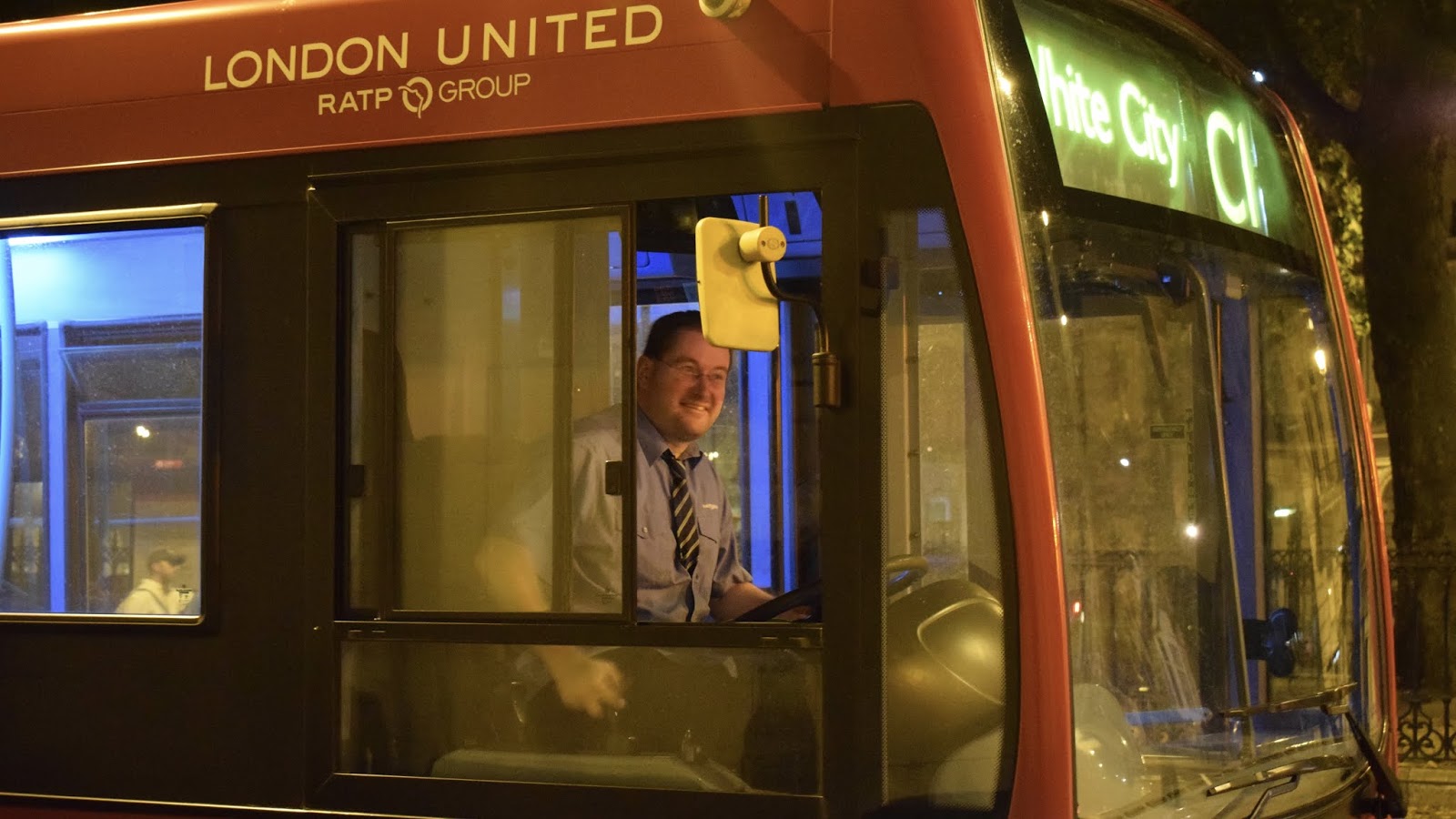
We fulfil our rationale by acting out the simple courtesies that can make a refreshing change to our experience of the daily commute. Acknowledge your bus driver when you jump on or off a bus!


Also see a shorter version @sayhicampaign.
Share:

Polls and Results! P1

Some screenshots below of the results of those who responded and engaged with our general social survey!


Share:

POSTER: Challenge the Consultation


Share:

Bus vs. Car - who wins?

Aboard route 321. A trip between New Cross Gate Station and New Cross Sainsbury's. (Yes, I couldn't be bothered to walk it and the 321 was conveniently there for me so allow it.)

©London Bus Breh.
The driver started departing the bus stop, exiting the bus lane onto the right lane towards New Cross Sainsbury's. However, he did not notice a car coming alongside the rear of the bus as he performed the lane change. This forced the car onto the opposite lane, swerving around the bus and assertively rejoining the correct side of the road in between the front of the bus and the queue of traffic at the lights. 

They then turned green, but the car driver was no longer in as much of a haste as their overtake suggested - they started accelerating, at a stubborn crawling pace. I looked at the rearview mirror located at the centre of the bus just behind the front windscreen to see the driver wave his hand in aggravation before the car driver gave up his antics to continue down New Cross Road as the road opened up onto a third lane for which the 321 takes to access Sainsbury's.

Unlike giving way, this opposing driving etiquette is nevertheless one of the many ways in which drivers interact through their vehicles. This engages with the micro-sociological spatiality of everyday life that Erving Goffman talks about (cited in Ben Highmore's 'Intrdouction: Questioning Everyday Life' in 'The Everyday Reader', p.11). For other unusual driving interactions, see Hamza's post.
Share:

Response to VIDEO

Just seen the video of the visit to the bus garage, looks great! Good work you guys that went, really think its important that we got the chance to have a real, in depth talk with those that work on transport to full understand their perspective and show to them that there are people that want to challenge the awkward atmosphere of London Transport.
Share:

VIDEO: Say Hi! Campaign

We feel that there is an unspoken but widely recognised awkwardness regarding interaction with public transport workers. For example, the customary habit of not acknowledging a bus driver when you jump on or off a bus or confronting Underground workers for delays that more often than not is out of their control. The Say Hi! Campaign has visually addressed this on our socials - this short film highlights the political implications of this negative-leaning perception of the bus driver or negative-leaning relationship between commuters and passengers. 

Therefore, by collecting public opinions of bus drivers and integrating them with driver interviews, this short film offers a scope for improved interactions between commuters and public transport staff and vice versa.


Thank you to Abellio London and Battersea Bus Garage for giving us access to their facilities and their staff. Seeing drivers for who the individuals they are, like the rest of us, outside of the cab is a refreshing experience that I would like to think this film shares with its audiences and that our project values in its rationale to reduce the stigma of interaction on public transport.
Share:

INTERVENTION: Challenge the Consultation

Challenge the Consultation is slightly removed from our other two interventions to the extent that it does not immediately concern the direct interaction of physical communication between commuters and public transport staff. Say Hi! Campaign and Hospitality in Transit were more micro-level in their focus of everyday life in the domain of public transport. Challenge the Consultation concerns itself with the political implications of TfL's consultation programme on a macro-level analysis of everyday life.

While TfL's consultation programme invites public response to inform considerations of service changes around our transport network, more often than not public response is not reflected in the outcome of decisions made to progress with TfL's proposed changes. I strongly believe this is microcosmic of the interactional breakdown between politicians and constituents, whereby politicians only look at policies from a macro-level of understanding - e.g. "cost-efficiency" has been the justificatory rhetoric for the withdrawal of many longstanding London bus routes - rather than engage with more micro-level demographic concerns with the policy - e.g. interchanging, having to adjust custom journey patterns because your customary service is no longer available or no longer running along the same route it had done to the convenience of its communities for many years.

Hence, I wanted to challenge the consultation by offering more community-friendly and journey-efficient alternatives to those proposed and implemented against public response invited but ultimately ignored by TfL's consultation programme. We created a poster to stick over the information sheets at bus stops for routes that have changed against public response such as route 23. This route used to run to The City from Westbourne Park. However, route 10 between King's Cross and Hammersmith was withdrawn and the 23, seemingly unrelated other than both routes paralleled on Oxford Street, became its replacement. The 23 now runs to Hammersmith via Park Lane, Knightsbridge and Kensington, even though at Paddington the 27 already does this quicker in the other direction. This effectively removed yet another link from west London into central and has rendered the 23 almost useless between Paddington and Hammersmith, with the small exception that Edgware Road is now directly linked to the Royal Albert Hall. Compare the amount of passengers doing that journey to the amount that used to take the 23 to the West End and right into The City - St. Paul's, Bank, Liverpool Street - and we see the macro-level cost-efficiency objectives in action against the macro-level conveniences expressed by commuters who use the services daily.


Unfortunately, it does not look like I will have the time to post up our posters at the relevant bus stops. However, to compensate I have published them on Flickr. We received generally positive feedback. Alex Peak, for example, replied that 'there’s a systemic problem with these consultations. It’s either too many different voices or one person making all the decisions and getting it wrong.' This is what motivated me to include Challenge the Consultation in the project.

I also shared the idea with the bus blogosphere on our featured blog London Connected. Responses were similarly interested in the idea and critical of the consultations:


Share:

INTERVENTION: Say Hi! Campaign

The Say Hi! Campaign has been integral to the rationale of our project: to relieve the stigma of interaction on public transport. It has taken numerous forms: on Instagram, we have provided anecdotes and quotes from the everyday commute; on SoundCloud, we have collected voice notes discussing public perception of bus drivers. Now, we have physically implemented our intervention with exclusive access to bus drivers from Battersea Bus Garage to get an insight into the everyday life of the bus driver. We discussed the importance of interaction between drivers and passengers, and the important of the bus on a wider consideration of public transport. More importantly for our rationale, we got to know drivers for who they are, like the rest of us, outside of the cab thus outside of the negative perception that surrounds their job. 

Say Hi! Campaign short film coming soon.
Most importantly, while there is a negative-leaning perception of bus drivers, our visit reinforced the fact that outside the spatial confinements of the driver's cab from which perceptions of the bus driver are visualised, they are just one of us. Working people, providing a service. In one of our interviews, bus driver and administrator Ezeta Coleman argues that bus drivers are not acknowledged. This is realised when lost property customers fail to provide descriptions of the bus driver who was driving the bus on which the customer's item was lost. Additionally, commuter attitudes towards bus drivers such as "I'm paying your wages" because they are paying for travel, despite the fact that bus drivers represent the same socio-economic background as most of their commuters, reinforces the political implications of the often negative anecdotes of interactions between commuters and driving staff.

We also explore the spatial politics between bus drivers and other road users. For example, what I have observed is the scenario whereby a bus is trying to pull out of a bus stop onto the main lane but other road users are not giving way; another bus behind at the bus stop might then pull out to form a momentary blockade to let the bus in front out. A good metaphor for this is that bus drivers are trying to join an onrush which is the everyday life struggle of any working citizen towards progress, but the onrush is inconsiderate of their fellow proletarian, to give it Marxist undertones. Sometimes, though, one person might stick out their hand to stop the onrush to let their fellow proletarian through. Spatial politics of the road, therefore, reinforce suggestions of this negative-leaning perception of bus drivers that Anton, along with many others like ourselves, feel is inherent within the public transport network.


The Say Hi! Campaign does not intend to instil some sort of victim mentality concerning bus drivers and depict the public as the enemy. Indeed, as you shall see in the short film I am currently editing, bus drivers too can make interaction on public transport less appealing between themselves and their passengers. Dennis and Marlon highlight that bus drivers have a duty to keep their passengers safe and well-informed. When a passenger comes on and asks a driver a question, but the driver is unwilling to talk, dismisses them or confronts them, that is a sign of the stigma of interaction on public transport that creates the divisions our rationale aims to tackle.

We gained an exclusive insight to the everyday life of bus drivers from visiting Battersea Bus Garage and I can't wait to complete this intervention with this short film that aims to create an interactive aura concerning commuters and bus drivers. Thank you to Abellio London for helping us with our project.
Share:

Bus Garage


This week me, Hamza, Hanna and Isaiah took a trip down to Queenstown Road bus garage.

The reason for this was to engage and interact with the employees who are assigned to the Abellio bus garage.
It was an amazing experience and opportunity to discuss first hand with those who are integral in our day to day lives and travels, making sure everything runs as efficiently as possible.


Thank you to everyone at Abelio particularly Ezeta, Marlon and Dennis who were really accommodating.
Below are some of pictures taken from our intervention spent at the bus garage.


Share:

Upload Alertttt!

Hey guys,
after yesterdays polls and research, I've managed to get some people to explain how they feel about Tfl and aspect of everyday

One is an artist who focuses much of his work and writing on inspiration underground and is a fellow student at our university!
check it out by clicking here

Another is of an economics student who graduated and currently works for a think tank who improve our services in London
It's short and sweet as she did not have much time to provide but thankful for her contribution!!
check it out!

Enjoy your day, stay smiling at your fellow commuters, relieving stigma!!
Share:

Bus Stop Poster Idea - Response

The reason it fits in with the intervention is because on a political level, the outcomes of public consultations have gone against the public response it invites. This is politically loaded because it is a microcosmic display of the limited interaction between politicians and their constituents when it comes to negotiating policies that affect everyday life, especially problematic if we consider ourselves a participatory democracy.

The modification of route 23 has reduced the number of services from its sections in west London that link to The City to none. As a result of what TfL call "cost-efficiency" objectives, the average commuter has to make adjustments to their everyday commute. Our rationale is not necessarily focused on interaction between commuters, rather all types of interaction related to public transport, whether that be indeed between commuters, between commuters and public transport staff, or between the public and transport policy-makers. The latter is why we should Challenging the Consultation.
Share:

Instagram: @sayhicampaign

Undergoing a little poll/quiz and survey on the Instagram page!!!
If anyone has some time to pop over and engage, that would be amazing

@sayhicampaign
@sayhicampaign

also, you can see some short clips of our intervention of hospitality!!


Will be sharing results from posts tomorrow!
Until then, go and like our posts!!

Share:

Meet your new bus drivers!


Share:

BUS GARAGE INTERVENTION!

So this week me, Isiaih, Hamza and Mohammed had loads of fun popping down to Queenstown Road bus station.

We had the opportunity to engage and interact with those who work Abellio bus garage!
It was an insightful and great experience to discuss with those who are involved in our everyday commutes and ensuring everything runs smoothly.

Thank you to everyone at Abelio particularly Ezeta, Marlon and Dennis who were amaazing!!!
Below are some pictures from our intervention of spending the day at the bus garage!
Keep your eyes out for the production soon


Share:

Voice Notes

Hi Guys
I set up the Soundcloud for the voice notes.
I'll send you guys the email and password.
This is the link for it. I've uploaded two. One from someone from the public and another from my friend.
https://soundcloud.com/user-197117786.

Share:

Bus Stop Poster Idea

I feel like that Bus stop directions idea we had is dissimilar in nature to our rationale or the intervention. I think a better way to streamline it so it fits the rest of the project would be if we argued that faster and simpler travel for passengers would allow people to worry less about directions or if they are going to be late or not, thus freeing them up to be more sociable to fellow passengers and members of staff. As too many times, people can be too busy working out where they are going or if they'll will be able to get there in time to even consider conversing with anyone unless it is a must.
Share:

VIDEO: Hospitality in Transit

We offer an interactive hospitality service at St. John's Station to provide all commuters with that first-class privilege otherwise restricted to the few who can afford it. Our aim: to relieve the stigma of interaction on public transport. Politically loaded to challenge the spatial barriers to communication that have the implications of reaffirming class divisions on public transport.


Edited by Isaiah Egwuagu.
Narrated by Katy Davidson.
Share:

Free Tea at St. John's Station

I met up with Katy to complete one of our three interventions: Hospitality in Transit, a.k.a. Katy's Hospitality Service. It went much better than we expected!


One of the things that has set us back during this project is conforming to the procedural approach of asking for permissions. So we took it upon ourselves to set up a hospitality service at an isolated station with infrequent services where passengers could be either alone and/or waiting a while for their trains. Katy chose St. John's Station, which proved a brilliant choice as not only did commuters show appreciation for it - whether or not they had some tea or not - but the platform staff equally embraced it to the extent that they actually started offering commuters our service!

Katy and I used our skills from working in hospitality to entice commuters to our service. I also set up my camera on the bench pictured below to record some of the interaction for a short film documenting our intervention. I came back the week after the intervention to do some additional  scenic filming to complete the final edit.


Overall, Hospitality in Transit shows that a hospitality service at train stations can increase the scope for interaction towards relieving the unspoken awkwardness of interaction on public transport. From learning about the demands of being a platform guard to discovering a shared trait for on-the-cusp tardiness with another commuter, Hospitality in Transit turned one of the most isolated and quietest stations in London, to potentially the most interactive!

Perhaps with the cohesive capacity and extended planning, our catering intervention could be trialled at stations in north, south, east and west to see how the levels of interaction on public transport, or the opportunity for it, varies according to which side of London you are in. Us Chatty Commuters have learnt that Hospitality in Transit is best implemented at quiet stations, where the commute is less busy hence the potential for a more interactive commuting experience is achievable. All-in-all, satisfied with how this one went. Well done, Katy!
Share:

INTERVENTION: Hospitality in Transit!

We did our first intervention of the project! What began as the 'Bus Stop' intervention has evolved into what we're calling Hospitality in Transit.

What the aim was:
As explained in the previous post about the Bus Stop Intervention, what we wanted to do was produce an experience that would relieve the stigma around communication on transport and generate a positive atmosphere for everyone we came into contact with. We wanted to do this by providing a hospitality service that would have a positive impact on people's day and also act as a conversation starter between us and those around us. Considering our other interventions are bus focused, on this one we decided to shift to an alternative mode of transport so chose a train station. Additionally we wanted one that wasn't over crowded and one that didn't already have a shop so people would engage. After discussing the ones we knew of, we decided on St Johns station. This provided an alternative dimension as it is a very isolated station; only 2 platforms that's well away from the road.


What we actually did:
Wednesday, April 10th was the day we did the intervention. The logistics of providing a hospitality service took some consideration and after discussion, we decided to provide a hot drinks stand for anyone that was passing through. After gathering supplies in the morning, I met Isaiah and we made our way to the station where we set up. We put up some posters around the station to advertise what we were doing and used the posters I had made to draw attention as they had some shocking statistics of the realities of London Transport. Tea and coffee are things that a majority people enjoy and so I hoped it would be a product that most people would say yes to.


How it played out on the day:
Once we were all set up, we needed to begin engaging with those around us. Initially, it took a few minutes for us to figure out how to go about talking to people. Isaiah first went up and asking the conductor if he would like a hot drink, from there we asked passengers that were waiting for their train to arrive and then those getting off the train and leaving the station. As it got closer and closer to evening rush hour, the number of people that engaged with us picked up significantly and turned out to be hugely successful!

Of course the number of people taking tea was great, but it was the conversation that the small offering created that was the success of the day. Whether people accepted or declined to our offer there was always one question, "what's it for?". Our presence on this relatively small station was noticeable and therefore drew people in; they were curious of our intentions and wanted to find out more.
So we explained it to them. That were there with the intention of carrying out our aim - to relieve the stigma of interaction on public transport. We wanted to encourage communication of all types on the platform whether it was between the passengers with each other or the passengers and the station staff.  We had numerous interactions throughout the time we where there from 15 minute conversations where people wanted to know more about our University, degree or our modules to 1 minute interactions just to ask people how their day was going. But there were 2 that really stood out to me that I believe really enrapture the point of our intervention that day.

Firstly was with one of the platform conductors. This gentleman was named Nana and was one of two conductors running St Johns station. We started out by providing him with a beverage, asking about his day and explaining to him our intervention. He was discussing with us which stations he thought we'd have success at etc. However, after a while we really got an insight into what his job was like day to day. When we asked whether passengers interacted with him we got a varied response but a particularly interesting point was when Nana said that his interactions with passengers increased when it was dark; passengers tended to stand closer to him on whatever part of the platform he was on during the night. This was an aspect I hadn't thought of, probably something I maybe do subconsciously.  Here platform conductors are taking on another responsibility, whether they chose to or not, something we passengers take for granted. Although it was just a small thing Nana mentioned, I thought it was a really interesting point.
After some more small talk and Nana encouraging passengers to take a beverage on our behalf, he told us a story from just the week previously when he had been the only one working at the station. Nana spend most of his shift taking a women down from taking her own life by jumping in front of a train. He described how he noticed her down at the end of the platform, went down to confront her and talk to her in order to keep her engaged. Nana had to physically restrain the lady at one point, and managed to communicate with the train conductors office through a driver stationed at the platform to have the electricity to the whole station shut down. For one moment, the lady was able to escape Nana's watch and did manage to jump on the tracks from the platform but due to Nana's quick thinking and amazing conduct, she had no injuries and the police arrived soon after. We spoke to two conductors during our intervention and both had experienced, seen or knows of someone who has been involved in such a situation.  This is something that I don't think many people realise is a real part of the job of working on public transport; something which can have a serious impact on a persons life. Hospitality on transport allowed us to talk to Nana, hear his story and allow his to share it. This is some effort from us to allow staff to tell of what it's really like to work on transport and share the realities of the job to those who take the TFL staff for granted.


Other was a male and female, one of which was on crutches. This interactions was a lot shorter and they had just got off a train and where obviously intending to leave the station immediately. But with Nana's help, they agreed to take our offer of tea. When making the tea, I enquired to the lady how her journey and day had been, to which she replied 'not great'. However after just a few minutes of just talking, the five of us were laughing and smiling. Although it wasn't much, I truly hope and believe that small interaction helped to improve their day, putting a smile on their faces even if only for a few minutes.

All together, I think the intervention was real successful because it was simple. There was no pressure for the passengers or staff to engage but it was there if they wanted it, if it would contribute positively to their day. Our lengthy discussion hopefully improved his shift a bit, and showed to those around us that engaging in interaction with TFL staff is not a taboo but actually welcomed. Additionally, talking to passengers allowed us to open up the channels for communication between passengers and giving them tea would hopefully encourage them to pass the act of kindness forward so that they too contribute kindness to others they interacted with during the day. Thanks Isaiah for all your help in making the intervention a success and ensuring we had a great impact on the platform.




Share:

Popular Posts

Featured Post

Intervention

Our group have had many discussions in the workshop throwing out ideas at both ends of the spectrum of the conservative and the ridiculous!...

Search This Blog

Translate