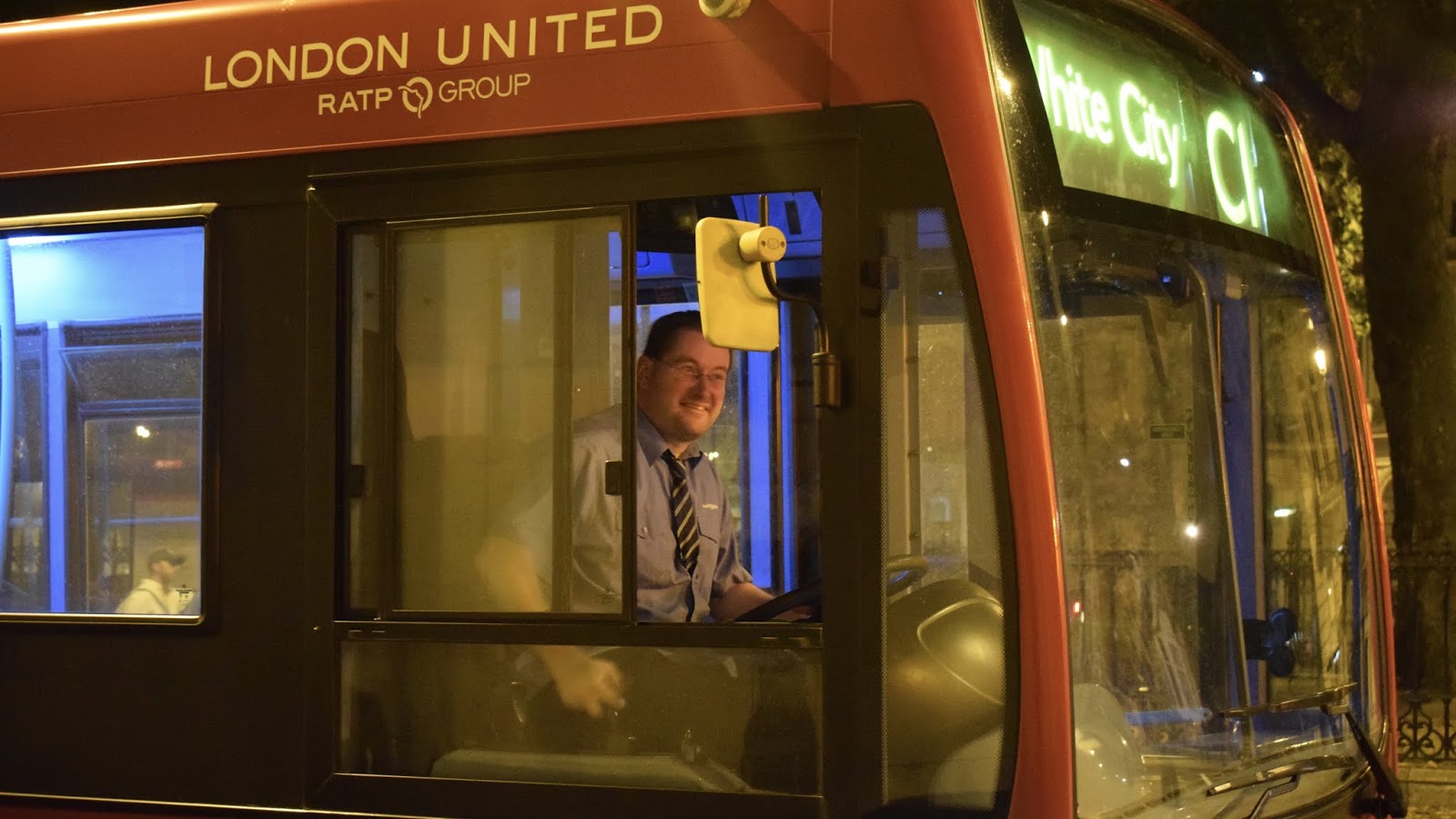
I also shared the idea with the bus blogosphere on our featured blog London Connected. Responses were similarly interested in the idea and critical of the consultations:
-
Chatty Commuters
Relieving the stigma of interaction on public transport.
-
-
Say Hi! Campaign
Acknowledge your driver when you jump on or off a bus to relieve the stigma of interaction on public transport.
-
Taxis, Uber, ViaVan
How has classical and new forms of cab service changed the potential for interaction between staff and customers in this mode of transport?
-
Challenge the Consultations
Does TfL's consultation programme really give the public agency over their public transport services or are their consultations merely a facade of democracy?
Showing posts with label Challenge the Consultation. Show all posts
INTERVENTION: Challenge the Consultation
Challenge the Consultation is slightly removed from our other two interventions to the extent that it does not immediately concern the direct interaction of physical communication between commuters and public transport staff. Say Hi! Campaign and Hospitality in Transit were more micro-level in their focus of everyday life in the domain of public transport. Challenge the Consultation concerns itself with the political implications of TfL's consultation programme on a macro-level analysis of everyday life.
While TfL's consultation programme invites public response to inform considerations of service changes around our transport network, more often than not public response is not reflected in the outcome of decisions made to progress with TfL's proposed changes. I strongly believe this is microcosmic of the interactional breakdown between politicians and constituents, whereby politicians only look at policies from a macro-level of understanding - e.g. "cost-efficiency" has been the justificatory rhetoric for the withdrawal of many longstanding London bus routes - rather than engage with more micro-level demographic concerns with the policy - e.g. interchanging, having to adjust custom journey patterns because your customary service is no longer available or no longer running along the same route it had done to the convenience of its communities for many years.
Hence, I wanted to challenge the consultation by offering more community-friendly and journey-efficient alternatives to those proposed and implemented against public response invited but ultimately ignored by TfL's consultation programme. We created a poster to stick over the information sheets at bus stops for routes that have changed against public response such as route 23. This route used to run to The City from Westbourne Park. However, route 10 between King's Cross and Hammersmith was withdrawn and the 23, seemingly unrelated other than both routes paralleled on Oxford Street, became its replacement. The 23 now runs to Hammersmith via Park Lane, Knightsbridge and Kensington, even though at Paddington the 27 already does this quicker in the other direction. This effectively removed yet another link from west London into central and has rendered the 23 almost useless between Paddington and Hammersmith, with the small exception that Edgware Road is now directly linked to the Royal Albert Hall. Compare the amount of passengers doing that journey to the amount that used to take the 23 to the West End and right into The City - St. Paul's, Bank, Liverpool Street - and we see the macro-level cost-efficiency objectives in action against the macro-level conveniences expressed by commuters who use the services daily.
Unfortunately, it does not look like I will have the time to post up our posters at the relevant bus stops. However, to compensate I have published them on Flickr. We received generally positive feedback. Alex Peak, for example, replied that 'there’s a systemic problem with these consultations. It’s either too many different voices or one person making all the decisions and getting it wrong.' This is what motivated me to include Challenge the Consultation in the project.
I also shared the idea with the bus blogosphere on our featured blog London Connected. Responses were similarly interested in the idea and critical of the consultations:
Bus Stop Poster Idea - Response
The reason it fits in with the intervention is because on a political level, the outcomes of public consultations have gone against the public response it invites. This is politically loaded because it is a microcosmic display of the limited interaction between politicians and their constituents when it comes to negotiating policies that affect everyday life, especially problematic if we consider ourselves a participatory democracy.
The modification of route 23 has reduced the number of services from its sections in west London that link to The City to none. As a result of what TfL call "cost-efficiency" objectives, the average commuter has to make adjustments to their everyday commute. Our rationale is not necessarily focused on interaction between commuters, rather all types of interaction related to public transport, whether that be indeed between commuters, between commuters and public transport staff, or between the public and transport policy-makers. The latter is why we should Challenging the Consultation.
Bus Stop Poster Idea
I feel like that Bus stop directions idea we had is dissimilar in nature to our rationale or the intervention. I think a better way to streamline it so it fits the rest of the project would be if we argued that faster and simpler travel for passengers would allow people to worry less about directions or if they are going to be late or not, thus freeing them up to be more sociable to fellow passengers and members of staff. As too many times, people can be too busy working out where they are going or if they'll will be able to get there in time to even consider conversing with anyone unless it is a must.
Route C2 withdrawn against majority opposition
Route C2 is the latest to be withdrawn from service against public response to Transport for London's consultation proposing the service change.
When TfL released the consultation for this service change, which involves extended route 88 to Parliament Hill Fields and re-routing the service via otherwise unparalleled sections of the C2, this proposal was met with a 65.45% opposition in public response. Only 15.67% supported the proposal, with concerns ranging from simply withdrawing the C2 to the impact the extension of the 88 in place of the withdrawn route C2 would have on reliability. Further concerns directed at the consultations themselves stated that they merely seem to be 'tick-box' exercises whereby concerns are not listened to and I feel that, at the very least, concerns are for the most part not reflected in TfL's decisions to go ahead with these service changes. Otherwise, we would still have a C2.
![]() |
| A bit like buzzwords from learning outcomes at school, the consultation state the opportunity for respondents to express their concerns, whilst skirting around the effectiveness of public response in determining the outcome of the consultation. Source: Proposed changes to bus routes 88 and C2 - Consultation Report (December 2018). |
You can read more about the withdrawal of the C2 on London Connected, where it is additionally voiced by the author that, while many locals have adjusted to the service change, 'they probably wouldn't have had much choice' but to do so anyway.
Intervention
IsaiahApril 07, 2019Challenge the Consultation, Hospitality in Transit, Say Hi! Campaign
No comments
Our group have had many discussions in the workshop throwing out ideas at both ends of the spectrum of the conservative and the ridiculous! There have been periods of confusion, discouragement and skepticism as to which idea should be the main focus for our intervention and how we should move forward with our project. However, we are now at a stage where one intervention is inadequate to relieve the stigma of interaction on public transport. Therefore, we present a number of interventions that we plan to complete in the next two weeks.
Intervention 1
Say Hi! Campaign
The Say Hi! Campaign intends to relieve the stigma of interaction on public transport by sharing anecdotal experiences from using public transport on Instagram and Twitter. The campaign shall be completed by a short film demonstrating how simple it is to acknowledge a driver when boarding or alighting a bus. A YouTube channel shall be created shortly onto which we can upload our final edit.
The Say Hi! Campaign is very much a visual campaign which, fuelled by our rationale, seeks to address this stigma of interaction by restoring a sense of community between customers and transport workers that we feel is largely absent in London. This is despite our transport services being integral to everyday life in our city. After all, public transport is "the lifeblood that keeps London flowing".
The political implications of such a disconnect between public transport staff and members of the public is a growing sense of alienation. Public transport staff are undermined as low-paid workers which then constructs a stereotypical social structure whereby their job defines their low social status, despite the vitality of the jobs of public transport staff to our everyday life. Our campaign peers beneath the stereotypes and the stigma of interaction they consequently ooze.
We would like to think that our intervention could encourage a self-reflecting audience towards getting to know and empathise with the people providing their services - i.e. with each other. As our most recent Instagram post suggests, at the end of the day inside or outside the cab of a bus or train or taxi, "we are all the same" in the inclusive macro sense of the term: public transport staff are just one of us.
Intervention 2
Challenging the Consultation
Transport for London use their consultation programme to invite the public to share their thoughts on proposed service changes. However, whether supported or not supported by the consultation vote results, changes, cutbacks and withdrawals have intervened with the way local services run irregardless of demand or service tradition as a symbolic part of one's community.
![]() |
| The percentage number of responses supporting these changes do not correspond with the fact that these changes went ahead, anyway. Challenge the Consultation. Baker Street Corridor | TfL bus service proposal |
Therefore, our second consultation is a politically loaded challenge of democracy: does the TfL consultation programme give a voice to the public in negotiating transport policy or does it merely give off the facade of democracy? The implementation of service changes against the response of the public shows a breakdown of communication between voters and politicians. These are two parties which, ironically, do not interact in the democracy, politically-speaking, in which we live.
To challenge the consultation's blatant disregard to the public response it invites, I plan to work with Bethel to create information sheets replicating that found on bus stops displaying route information to then stick over the route information of services recently changed - specifically those which have gone against public response - with our more journey-efficient alternatives.
Intervention 3
Katy's hospitality service
We are thinking to provide a hospitality service at either bus stops or train stations served by infrequent lines or routes to entertain passenger waiting time, or provide the hospitality service onboard public transport. This intervention is a subtle challenge to first-class service that is restricted to the few that can afford the privilege. Such stratifications only contribute to the stigma of interaction, financial capital again the defining theme behind it.
If we are to provide our own hospitality service on public transport services or at public transport stations, everyone is able to enjoy the service without the class restrictions that separate one group of commuters from another. Katy and I can draw from our experiences working in the hospitality sector to inform a plan of action for this intervention.


