Also see a shorter version @sayhicampaign.
-
Chatty Commuters
Relieving the stigma of interaction on public transport.
-
-
Say Hi! Campaign
Acknowledge your driver when you jump on or off a bus to relieve the stigma of interaction on public transport.
-
Taxis, Uber, ViaVan
How has classical and new forms of cab service changed the potential for interaction between staff and customers in this mode of transport?
-
Challenge the Consultations
Does TfL's consultation programme really give the public agency over their public transport services or are their consultations merely a facade of democracy?
Showing posts with label Say Hi! Campaign. Show all posts
VIDEO: Spin around Battersea Bus Garage
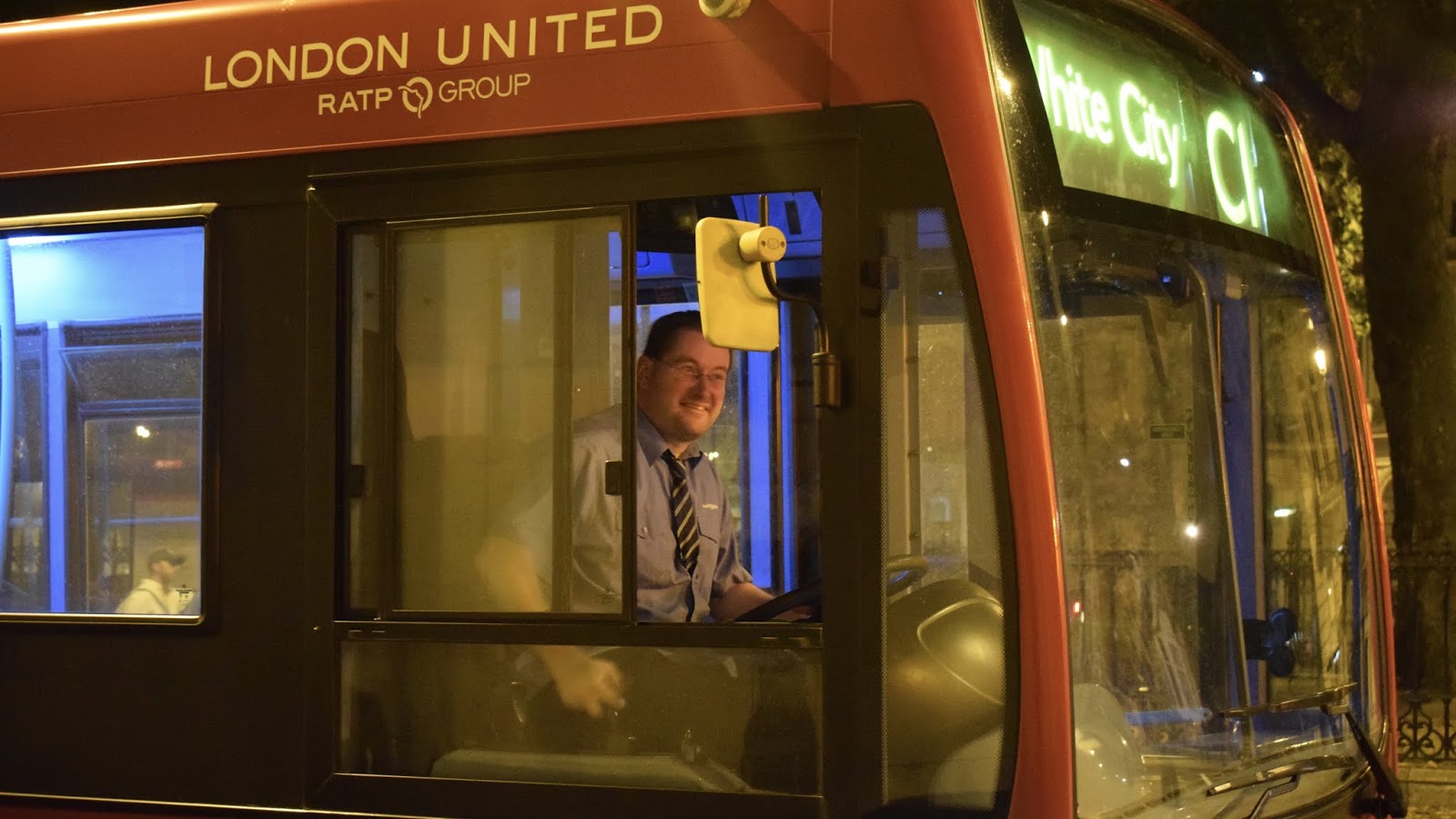
We fulfil our rationale by acting out the simple courtesies that can make a refreshing change to our experience of the daily commute. Acknowledge your bus driver when you jump on or off a bus!
Also see a shorter version @sayhicampaign.
Bus vs. Car - who wins?
Aboard route 321. A trip between New Cross Gate Station and New Cross Sainsbury's. (Yes, I couldn't be bothered to walk it and the 321 was conveniently there for me so allow it.)
![]() |
| ©London Bus Breh. |
The driver started departing the bus stop, exiting the bus lane onto the right lane towards New Cross Sainsbury's. However, he did not notice a car coming alongside the rear of the bus as he performed the lane change. This forced the car onto the opposite lane, swerving around the bus and assertively rejoining the correct side of the road in between the front of the bus and the queue of traffic at the lights.
They then turned green, but the car driver was no longer in as much of a haste as their overtake suggested - they started accelerating, at a stubborn crawling pace. I looked at the rearview mirror located at the centre of the bus just behind the front windscreen to see the driver wave his hand in aggravation before the car driver gave up his antics to continue down New Cross Road as the road opened up onto a third lane for which the 321 takes to access Sainsbury's.
Unlike giving way, this opposing driving etiquette is nevertheless one of the many ways in which drivers interact through their vehicles. This engages with the micro-sociological spatiality of everyday life that Erving Goffman talks about (cited in Ben Highmore's 'Intrdouction: Questioning Everyday Life' in 'The Everyday Reader', p.11). For other unusual driving interactions, see Hamza's post.
VIDEO: Say Hi! Campaign
We feel that there is an unspoken but widely recognised awkwardness regarding interaction with public transport workers. For example, the customary habit of not acknowledging a bus driver when you jump on or off a bus or confronting Underground workers for delays that more often than not is out of their control. The Say Hi! Campaign has visually addressed this on our socials - this short film highlights the political implications of this negative-leaning perception of the bus driver or negative-leaning relationship between commuters and passengers.
Therefore, by collecting public opinions of bus drivers and integrating them with driver interviews, this short film offers a scope for improved interactions between commuters and public transport staff and vice versa.
Thank you to Abellio London and Battersea Bus Garage for giving us access to their facilities and their staff. Seeing drivers for who the individuals they are, like the rest of us, outside of the cab is a refreshing experience that I would like to think this film shares with its audiences and that our project values in its rationale to reduce the stigma of interaction on public transport.
INTERVENTION: Say Hi! Campaign
The Say Hi! Campaign has been integral to the rationale of our project: to relieve the stigma of interaction on public transport. It has taken numerous forms: on Instagram, we have provided anecdotes and quotes from the everyday commute; on SoundCloud, we have collected voice notes discussing public perception of bus drivers. Now, we have physically implemented our intervention with exclusive access to bus drivers from Battersea Bus Garage to get an insight into the everyday life of the bus driver. We discussed the importance of interaction between drivers and passengers, and the important of the bus on a wider consideration of public transport. More importantly for our rationale, we got to know drivers for who they are, like the rest of us, outside of the cab thus outside of the negative perception that surrounds their job.
![]() |
| Say Hi! Campaign short film coming soon. |
Most importantly, while there is a negative-leaning perception of bus drivers, our visit reinforced the fact that outside the spatial confinements of the driver's cab from which perceptions of the bus driver are visualised, they are just one of us. Working people, providing a service. In one of our interviews, bus driver and administrator Ezeta Coleman argues that bus drivers are not acknowledged. This is realised when lost property customers fail to provide descriptions of the bus driver who was driving the bus on which the customer's item was lost. Additionally, commuter attitudes towards bus drivers such as "I'm paying your wages" because they are paying for travel, despite the fact that bus drivers represent the same socio-economic background as most of their commuters, reinforces the political implications of the often negative anecdotes of interactions between commuters and driving staff.
We also explore the spatial politics between bus drivers and other road users. For example, what I have observed is the scenario whereby a bus is trying to pull out of a bus stop onto the main lane but other road users are not giving way; another bus behind at the bus stop might then pull out to form a momentary blockade to let the bus in front out. A good metaphor for this is that bus drivers are trying to join an onrush which is the everyday life struggle of any working citizen towards progress, but the onrush is inconsiderate of their fellow proletarian, to give it Marxist undertones. Sometimes, though, one person might stick out their hand to stop the onrush to let their fellow proletarian through. Spatial politics of the road, therefore, reinforce suggestions of this negative-leaning perception of bus drivers that Anton, along with many others like ourselves, feel is inherent within the public transport network.
The Say Hi! Campaign does not intend to instil some sort of victim mentality concerning bus drivers and depict the public as the enemy. Indeed, as you shall see in the short film I am currently editing, bus drivers too can make interaction on public transport less appealing between themselves and their passengers. Dennis and Marlon highlight that bus drivers have a duty to keep their passengers safe and well-informed. When a passenger comes on and asks a driver a question, but the driver is unwilling to talk, dismisses them or confronts them, that is a sign of the stigma of interaction on public transport that creates the divisions our rationale aims to tackle.
We gained an exclusive insight to the everyday life of bus drivers from visiting Battersea Bus Garage and I can't wait to complete this intervention with this short film that aims to create an interactive aura concerning commuters and bus drivers. Thank you to Abellio London for helping us with our project.
Upload Alertttt!
Hey guys,
after yesterdays polls and research, I've managed to get some people to explain how they feel about Tfl and aspect of everyday
One is an artist who focuses much of his work and writing on inspiration underground and is a fellow student at our university!
check it out by clicking here
Another is of an economics student who graduated and currently works for a think tank who improve our services in London
It's short and sweet as she did not have much time to provide but thankful for her contribution!!
check it out!
Enjoy your day, stay smiling at your fellow commuters, relieving stigma!!
after yesterdays polls and research, I've managed to get some people to explain how they feel about Tfl and aspect of everyday
One is an artist who focuses much of his work and writing on inspiration underground and is a fellow student at our university!
check it out by clicking here
Another is of an economics student who graduated and currently works for a think tank who improve our services in London
It's short and sweet as she did not have much time to provide but thankful for her contribution!!
check it out!
Enjoy your day, stay smiling at your fellow commuters, relieving stigma!!
Instagram: @sayhicampaign
Undergoing a little poll/quiz and survey on the Instagram page!!!
If anyone has some time to pop over and engage, that would be amazing
@sayhicampaign
@sayhicampaign
also, you can see some short clips of our intervention of hospitality!!
Will be sharing results from posts tomorrow!
Until then, go and like our posts!!
If anyone has some time to pop over and engage, that would be amazing@sayhicampaign
@sayhicampaign
also, you can see some short clips of our intervention of hospitality!!Will be sharing results from posts tomorrow!
Until then, go and like our posts!!
BUS GARAGE INTERVENTION!
So this week me, Isiaih, Hamza and Mohammed had loads of fun popping down to Queenstown Road bus station.
We had the opportunity to engage and interact with those who work Abellio bus garage!
It was an insightful and great experience to discuss with those who are involved in our everyday commutes and ensuring everything runs smoothly.
Thank you to everyone at Abelio particularly Ezeta, Marlon and Dennis who were amaazing!!!
Below are some pictures from our intervention of spending the day at the bus garage!
Keep your eyes out for the production soon
We had the opportunity to engage and interact with those who work Abellio bus garage!
It was an insightful and great experience to discuss with those who are involved in our everyday commutes and ensuring everything runs smoothly.
Thank you to everyone at Abelio particularly Ezeta, Marlon and Dennis who were amaazing!!!
Below are some pictures from our intervention of spending the day at the bus garage!
Keep your eyes out for the production soon
Voice Notes
Hi Guys
I set up the Soundcloud for the voice notes.
I'll send you guys the email and password.
This is the link for it. I've uploaded two. One from someone from the public and another from my friend.
https://soundcloud.com/user-197117786.
I set up the Soundcloud for the voice notes.
I'll send you guys the email and password.
This is the link for it. I've uploaded two. One from someone from the public and another from my friend.
https://soundcloud.com/user-197117786.
What is your opinion of bus drivers?
Another source to draw from for tomorrow's visit. Many interesting things to learn from this video, including the stereotype that all bus drivers are miserable, the negative-leaning perceptions of bus drivers and the perks of being a bus driver.
DoubleDeckerAnton: What is your Opinion of Bus Drivers?
Abuse on TFL
On my normal journey to meet my friends on the VERY hot central line towards Epping going to Leytonstone. I had stopped Tracy who was going from carriage to carriage checking to see if everyone had a valid payment method. As she took my Oyster to check if it was valid I took my advantage with asking some questions;
Me: Hey, I'd like to ask a few questions for a blog I'm doing for my University if you don't mind
T: Hi, of course not these little things make my job that much more fun
Me: Tell me a good and bad experience you've had whilst working here if you don't mind
T: Well, I've been working for TFL for over five years and you can only imagine what I've been through. The best moments are having people who stop and just say Hi. Honestly it makes me day because everyone else acts as if you're a stranger and just there to direct them to different lines, show them the routes, and more. The challenge and bad parts of this job is working on the weekends. As much as it's fun I've witnessed a lot of anti social behaviour.
Me: When you say anti social behaviour can you discuss what you mean maybe?
T: In terms of a series of people going out on the weekend getting drunk which is completely fine however, most of the direct contact comes from drunk people. They get loud, violent, and all sorts. Which is why certain laws have been put into where people can no longer drink alcohol or carry open containers of alcohol on public transport. That including buses, trams, tubes.
Me: How do you deal with that such behaviour or challenges?
T: With kindness. In terms of dealing with it can be difficult as I'm small I have been all my life so I pretty much try to get my other colleagues to help. It can be hard because everyone is different and you to deal with everyone differently. But the policies are quite straightforward.
Me: Thank you so much for answering my questions I'm cutting it short as the next stop is me but could I potentially take a picture of you or with you?
T: I'd love to however my kids would be so embarrassed if I did. So I'll have to decline.
In essence, the dealings of the everyday life on TFL is very different for different people. The abuse they face on a daily basis is very evident and is highlighted on weekends.
As far as being more cautious of TFL workers everyone should be!
Have a good day and Say Hi! to a driver.
Tube Chat in Motion
I was a standee on the Bakerloo Line, relaxing against the handrail in today's humidity. Two passengers seated nearest to me had alighted, but I did not realise. Uncommon for the notoriously low interactional levels on the London Underground, a man - around senior age - gesticulated towards me to catch my attention and informed me that there were now two seats available to sit on. I told him I was getting off the next stop, but thanked him for his consideration before returning the interactional favour by catching his attention to wish him a good day before I myself alighted the next stop. I admittedly walked towards the doors with some haste to walk away from the attention I had created for ourselves to reinforce the fact that there is that awkwardness surrounding interaction on public transport, but more important to me was asserting a kind gesture back to the man.
As banal an anecdote it is, considerate and polite interaction like this is unfortunately not the norm on public transport, especially in London. Hence it is moments like these that I come to appreciate and, upon reflection, there is an additional appreciation for this module in that it embraces such banalities of everyday life that are otherwise left unspoken in common discourse and further left under-acknowledged by the generally theoretical sphere of academia.
Gender pay gap
Something is seen in all fields of work and multiple roles, the gender pay gap. In an economy and democracy as liberal as Britain, it's shocking to see this to be an issue across multiple sectors and careers.
I began researching after speaking to a familiar bus driver (Driver B as she does not want her identity to be disclosed) who has been driving the 1 bus from Canada Water to Tottenham Ct Rd for many years (since I was in secondary school!) and has seen many challenges like difficult school kids, rowdy drunks on the N1 and frankly difficult commuters.
As a young, black female bus driver she has faced animosity and stigma in the role previously dominated by men in regards to her: shift pattern, her routes, and even her driving!!
Driver B enjoys her job and loves seeing her locals that get on during the day and the sense of community it brings her to know she's supporting the movement as she was one of the first female drivers I can recall ever seeing growing up in SE16.
She briefly mentioned to me before I needed to get off the inequality in pay making me stumble across this article discussing Sadiq Khans efforts in reducing the pay gap and how far he has got. Have a read and a beautiful day!! Enjoy your journeys and notice something new, say hi to a driver; ask a question or few.
I began researching after speaking to a familiar bus driver (Driver B as she does not want her identity to be disclosed) who has been driving the 1 bus from Canada Water to Tottenham Ct Rd for many years (since I was in secondary school!) and has seen many challenges like difficult school kids, rowdy drunks on the N1 and frankly difficult commuters.
As a young, black female bus driver she has faced animosity and stigma in the role previously dominated by men in regards to her: shift pattern, her routes, and even her driving!!
Driver B enjoys her job and loves seeing her locals that get on during the day and the sense of community it brings her to know she's supporting the movement as she was one of the first female drivers I can recall ever seeing growing up in SE16.
She briefly mentioned to me before I needed to get off the inequality in pay making me stumble across this article discussing Sadiq Khans efforts in reducing the pay gap and how far he has got. Have a read and a beautiful day!! Enjoy your journeys and notice something new, say hi to a driver; ask a question or few.
Intervention 1: Bus Garage
So after Isaiah's post you guys know the basic idea of the intervention now that we've heard back from the bus garage.
When us two met on Monday we just brain stormed a few ideas of what to talk about when we go ahead with these interviews. These are the questions we'll put to the people we talk to:
- How often do people talk to you?
- Do people make the effort to smile, be polite or ask about your day?
- Do you think people see you as an extension of the service rather than a real person? Do you think the glass protection contributes to this dehumanizing
- Do you think people recognise the difficulties of working on public transport? Health problems, mental health issues or abuse.
- Do you see other passengers interact with each other?
- Do you think there is a stigma around communication on public transport? Between passengers, staff or management.
- Whats the worst things that you've seen or had to experience on your job?
- How would you evaluate the interaction and communication between service controllers and yourselves.
Add any other questions you think we should include!
Katy
Intervention
IsaiahApril 07, 2019Challenge the Consultation, Hospitality in Transit, Say Hi! Campaign
No comments
Our group have had many discussions in the workshop throwing out ideas at both ends of the spectrum of the conservative and the ridiculous! There have been periods of confusion, discouragement and skepticism as to which idea should be the main focus for our intervention and how we should move forward with our project. However, we are now at a stage where one intervention is inadequate to relieve the stigma of interaction on public transport. Therefore, we present a number of interventions that we plan to complete in the next two weeks.
Intervention 1
Say Hi! Campaign
The Say Hi! Campaign intends to relieve the stigma of interaction on public transport by sharing anecdotal experiences from using public transport on Instagram and Twitter. The campaign shall be completed by a short film demonstrating how simple it is to acknowledge a driver when boarding or alighting a bus. A YouTube channel shall be created shortly onto which we can upload our final edit.
The Say Hi! Campaign is very much a visual campaign which, fuelled by our rationale, seeks to address this stigma of interaction by restoring a sense of community between customers and transport workers that we feel is largely absent in London. This is despite our transport services being integral to everyday life in our city. After all, public transport is "the lifeblood that keeps London flowing".
The political implications of such a disconnect between public transport staff and members of the public is a growing sense of alienation. Public transport staff are undermined as low-paid workers which then constructs a stereotypical social structure whereby their job defines their low social status, despite the vitality of the jobs of public transport staff to our everyday life. Our campaign peers beneath the stereotypes and the stigma of interaction they consequently ooze.
We would like to think that our intervention could encourage a self-reflecting audience towards getting to know and empathise with the people providing their services - i.e. with each other. As our most recent Instagram post suggests, at the end of the day inside or outside the cab of a bus or train or taxi, "we are all the same" in the inclusive macro sense of the term: public transport staff are just one of us.
Intervention 2
Challenging the Consultation
Transport for London use their consultation programme to invite the public to share their thoughts on proposed service changes. However, whether supported or not supported by the consultation vote results, changes, cutbacks and withdrawals have intervened with the way local services run irregardless of demand or service tradition as a symbolic part of one's community.
![]() |
| The percentage number of responses supporting these changes do not correspond with the fact that these changes went ahead, anyway. Challenge the Consultation. Baker Street Corridor | TfL bus service proposal |
Therefore, our second consultation is a politically loaded challenge of democracy: does the TfL consultation programme give a voice to the public in negotiating transport policy or does it merely give off the facade of democracy? The implementation of service changes against the response of the public shows a breakdown of communication between voters and politicians. These are two parties which, ironically, do not interact in the democracy, politically-speaking, in which we live.
To challenge the consultation's blatant disregard to the public response it invites, I plan to work with Bethel to create information sheets replicating that found on bus stops displaying route information to then stick over the route information of services recently changed - specifically those which have gone against public response - with our more journey-efficient alternatives.
Intervention 3
Katy's hospitality service
We are thinking to provide a hospitality service at either bus stops or train stations served by infrequent lines or routes to entertain passenger waiting time, or provide the hospitality service onboard public transport. This intervention is a subtle challenge to first-class service that is restricted to the few that can afford the privilege. Such stratifications only contribute to the stigma of interaction, financial capital again the defining theme behind it.
If we are to provide our own hospitality service on public transport services or at public transport stations, everyone is able to enjoy the service without the class restrictions that separate one group of commuters from another. Katy and I can draw from our experiences working in the hospitality sector to inform a plan of action for this intervention.
Campaigning at Victoria
So on Tuesday Katy, Hamza, and I went to Victoria station to talk to commuters about our campaign and see what they thought about it. We chose Victoria because it is a busy station with lots going on. We printed out some leaflets that can be seen in a previous post by Katy which stated some staggering facts about abuse on TFL. Our aim was to raise awareness of these facts and hopefully create a happy positive atmosphere for staff and commuters. So our visit to Victoria was a test run for our main intervention, which in short, is to transform a normal plain bus stop into a happy place that will brighten people's day and hopefully they will pay this happiness forward to the staff that are driving their bus or other method of transport. It also helped us practice and become comfortable with approaching the public and getting their opinion.
So we started outside the tube station and because we were nervous we only started by handing our leaflets out but obviously this wasn't very effective. Therefore, we decided to start approaching commuters just for a chat about our idea. Hamza even asked the woman behind the Krispy Kreme counter what she thought! We asked them questions such as:
1. Do you engage in conversation with anyone when at the bus stop or waiting for the tube?
2. Do you acknowledge your driver?
3. How do you feel on your daily commute?
4. If the atmosphere you were waiting in was more happy and comfortable do you think this would impact on your experience and day?
5. Would you be likely to pass this happiness to other people?
The response we got was great! Currently, next to no one engaged in conversation with another commuter or even acknowledged their driver, only if they needed to ask a question or complain about delays. We also found that most people feel tired and miserable in the morning commute but drained and stressed on their evening commute. The commuters general consensus was that they would like to think that a nice atmosphere at the bus stop, for example music, coffee, comfy seats, would increase their mood and sociability. When observing the bus stops at Victoria, it was a depressing sight with everyone on their phone and their headphones in. Time for a change!
Tasha
So we started outside the tube station and because we were nervous we only started by handing our leaflets out but obviously this wasn't very effective. Therefore, we decided to start approaching commuters just for a chat about our idea. Hamza even asked the woman behind the Krispy Kreme counter what she thought! We asked them questions such as:
1. Do you engage in conversation with anyone when at the bus stop or waiting for the tube?
2. Do you acknowledge your driver?
3. How do you feel on your daily commute?
4. If the atmosphere you were waiting in was more happy and comfortable do you think this would impact on your experience and day?
5. Would you be likely to pass this happiness to other people?
The response we got was great! Currently, next to no one engaged in conversation with another commuter or even acknowledged their driver, only if they needed to ask a question or complain about delays. We also found that most people feel tired and miserable in the morning commute but drained and stressed on their evening commute. The commuters general consensus was that they would like to think that a nice atmosphere at the bus stop, for example music, coffee, comfy seats, would increase their mood and sociability. When observing the bus stops at Victoria, it was a depressing sight with everyone on their phone and their headphones in. Time for a change!
Tasha
ViaVan Trip
ViaVan Trip.
What's up guys, this morning I decided to take a ViaVan to work rather than TFL, to help with some of our intervention work. Usually if I do travel anywhere i'm more of an TFL user, so I was curious to see how this differed from public transport. Straight away there was a problem booking it because the drivers can only pick you up from certain areas in London. For the driver to pick me up I had to walk about 5 minutes from my house to the nearest pick up point. To be honest this felt very inconvenient as the closest bus stop to me is literally outside my house.
As soon as I got into the ViaVan I was curious to why my driver chose ViaVan over the popular Uber or even being a bus driver and whether they offered anything to entice drivers. When I asked these questions, the driver told me that the reason why he joined was that drivers were guaranteed £300 for their first 10 pick ups. I then asked him whether he liked to engage with riders, with which he replied it did not really bother him as he did not want to intrude if people were shy. He also told me that he did not want to work for TFL because of the strict schedule and with ViaVan he felt like his own boss.
Intervention Ideas: BUS STOP
Ideas for possible intervention:
In an effort to make transport more friendly and a better atmosphere for everyone involved, we need to make the place where people wait for this service friendly.
To do this, our intervention can be to improve the day of those waiting at bus stops, showing acts of kindness in order to project this kindness forward.
We can make a comfy, welcoming and friendly bus stop for anyone that comes through.
We could include:
· more available, make it more comfortable; use cushions or blankets to make it better depending on the weather
· decorations to make it happier and also draw more attention to what we are doing for any passers by
· offer hot coffee or biscuits or sweets as a sign of goodwill
· playing music to improve the atmosphere
When we do it, we can ask those that are taking part in our intervention to pass these acts of kindness forward in the time they are going to be on London Transport. This would be a simple act, that wouldn’t disrupt the everyday life of those using the bus but instead help to encourage it and better it.
To ensure that people are engaged with the ideas we are trying to spread, provide flyers and information on our campaign. This way we can hopefully instil our message through creating a memorable experience.
I think this would be a really good intervention as would draw some good attention from people as their curiosity would take over. But it isn't over the top and it doesn't overly impact their day so would be more likely that people take part.
#travelkind
The campaign was super successful and many find it helpful to spread awareness as many are intolerant and some do not pay attention to those around them!
As linking to my previous post the use of the badges and indicators have proven to be really helpful and successful.
The evening standard complied a post from the trending topic and many tweets were made. To see some more, check out the article by clicking here! Also, I have found a varied range of tweets from the hashtag myself, maybe I'll do another post with my own compilation!
Hanna!